A name with room to grow
English Heritage notes that medieval bestiaries used several overlapping words for dragon-like creatures, including wyrm, worm and serpent. The modern distinction between a four-legged dragon and a two-legged wyvern became clearer through later heraldic and artistic conventions.
That history already makes the dragon less like a species and more like a family of visual solutions. A body can be borrowed from a snake, a bird, a lizard or a collection of animals that no naturalist would accept as a single creature.
Water, sky and the world below
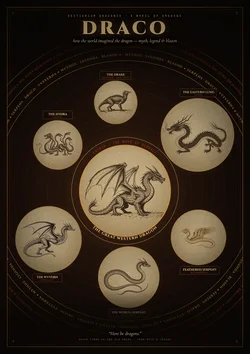
In the DRACO wheel, the western dragon carries four legs, wings and a reptilian head. The hydra multiplies the head. The wyvern pares the body down to wings and two legs. The world-serpent abandons wings and limbs altogether, becoming a boundary around the universe.
Eastern dragons follow another logic. They are often long and serpentine, associated with water, rain and storms rather than the fire-breathing guardian familiar from European fantasy. The change in anatomy is a change in territory and power.
A bestiary is a map of imagination
The dragon’s many bodies are not a problem to solve. They are a record of what different cultures needed the creature to do. It can guard a threshold, explain a storm, embody danger, carry a ruler or surround the world.
That is why a field guide suits the subject. A diagram lets the forms sit beside one another without forcing them into a single definition. The name stays stable for a moment, while the silhouette keeps moving.