The summer that made a monster
In 1816, Lord Byron rented the Villa Diodati on Lake Geneva with Percy Bysshe Shelley, Mary Godwin and Byron’s young physician, John Polidori. The weather kept them indoors. A ghost-story competition gave the strange summer a shape.
Byron began a fragment and abandoned it. Mary Godwin developed her own idea into Frankenstein. Polidori took the fragment seriously and changed its scale. His vampire was not a corpse haunting a village. He was Lord Ruthven, a polished aristocrat who could enter a drawing room, hold a conversation and leave a trail of ruined lives behind him.
A story published under Byron’s name
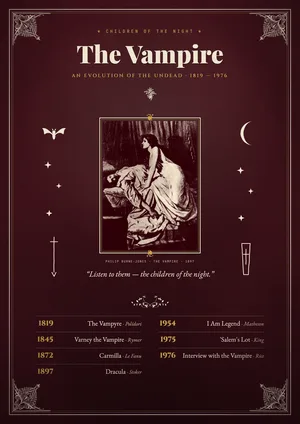
The Vampyre appeared in 1819 in The New Monthly Magazine with the false attribution “A Tale by Lord Byron”. Polidori had written the story, yet the Byron name was commercially irresistible. The mistake was printed before the author had a fair chance to correct it.
Polidori wrote to the magazine. A correction appeared the following month, but the first impression had already travelled. The confusion was reinforced by the name Lord Ruthven, borrowed from Glenarvon, the scandalous novel that had caricatured Byron. The modern literary vampire was born with a credit dispute built into his legend.
The shape that survived
Polidori died in 1821, aged twenty-five. Byron’s name continued to cling to pirated editions, while Polidori’s contribution was gradually absorbed into the larger history of gothic fiction. The aristocratic vampire remained.
That is why the vampire in literature makes such a good visual subject. The figure is a record of transformation: folklore becomes fashion, predation becomes seduction, and a night creature learns how to dress for the salon.