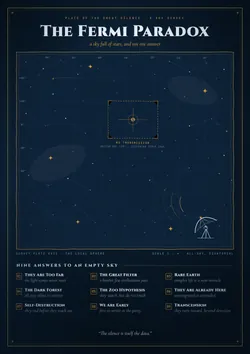
A question asked over lunch
In 1950, Enrico Fermi is said to have asked the question during a conversation with physicists at Los Alamos. The Milky Way is old, and a technological civilisation might in principle spread across it in a few million years, even without travelling at the speed of light.
The apparent contradiction is simple to state. If life and technology are common, why has no unmistakable trace appeared? The difficulty is that every part of the expectation contains an assumption about biology, survival, travel or communication.
Silence is not a measurement of absence
NASA describes the search for life beyond Earth as an open investigation. Thousands of exoplanets have been confirmed, yet Earth remains the only world known to host life. We have one confirmed example and a very large number of places we have barely begun to study.
That makes the silence difficult to interpret. It may reflect distance, timing, the limits of our instruments or the fact that we do not yet know which signs deserve attention. It does not, on its own, establish that other life is impossible or absent.
The value of asking carefully
The Fermi paradox is useful when it keeps those uncertainties visible. It separates what has been observed from the stories we use to fill the gap. A plausible explanation is not the same thing as evidence for that explanation.
That is the reason the question continues to matter. It does not shrink the universe into a single answer. It gives us a better way to speak about what we know, what we are looking for and what remains out of reach.