Before Ouija had a name
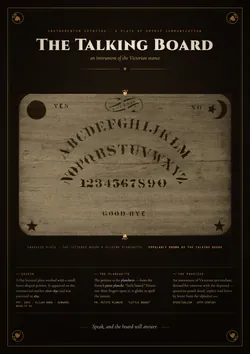
The board did not appear from nowhere. In 1886, newspapers reported that Spiritualists in Ohio were using a board marked with letters and numbers, together with a planchette-like pointer. It belonged to a broader nineteenth-century culture of automatic writing, table-turning and attempts to communicate with the dead.
The arrangement was simple enough for a parlour: an alphabet, a set of numbers, a small pointer and several people willing to wait for a message. The simplicity was part of the appeal. It made a private séance feel like an instrument anyone could place on a table.
Four years later, Charles Kennard formed the Kennard Novelty Company in Baltimore with investors including Elijah Bond and William Fuld. Their plan was commercial, not accidental: to make and sell talking boards under a distinct name.
The story the board told about itself
That name came with a ready-made ghost story. According to the account repeated by the SFO Museum, the group sought advice from the board while deciding what to call it. The pointer allegedly spelled “Ouija” and explained that the word meant “good luck.”
The important word is allegedly. The story is a founding legend, not proof that a board spoke. But it is also an unusually effective piece of product history. A toy company did not merely sell a board for receiving messages. It sold an object with a message about its own origin already attached.
That ambiguity has never left Ouija. It can be treated as an oracle, a game, a prop, an heirloom or a dare. Each use borrows some force from the others.
Why the board becomes urgent in uncertain times
The board’s popularity rose in the years around the First World War, when bereavement and uncertainty made a promise of contact especially powerful. The Smithsonian describes Ouija as an object that became most popular in periods when people were looking for answers and holding fast to belief.
That history gives the Halloween version of Ouija a sharper edge. The board is frightening not because it guarantees a ghost, but because it stages a human wish: to ask a question whose answer cannot be checked by ordinary means.
The mood can turn from curiosity to fear very quickly when everyone at the table feels the pointer moving and nobody wants to claim responsibility for the motion.
The movement without a ghost
Psychology has a name for one part of that experience: the ideomotor effect. It describes small muscular movements that can occur without conscious intention. Participants may feel that the planchette moves on its own while each person contributes tiny motions they do not notice.
That explanation does not erase the board’s cultural power. It helps explain why it works so well as a ritual object. Ouija makes uncertainty visible. A group watches a pointer travel across letters and must decide whether the movement belongs to a spirit, another person or the part of themselves they do not fully feel controlling.
The legend says the board named itself. The more interesting history is that people have kept giving it new names ever since: game, oracle, trick, comfort and Halloween dare.