A signal with the wrong kind of mystery
In 1963, Nikolai Kardashev studied the radio source CTA-102. The name was not a coded message. It was simply the 102nd entry in an early Caltech catalogue of radio sources. Its unusual properties made it worth attention, and the possibility of an artificial transmitter entered the discussion.
In 1965, observations showed that the source was varying. Gennady Sholomitsky announced the result, while Soviet astronomers considered whether an advanced civilisation might be responsible. A TASS journalist overheard the speculation on 12 April. The story reached the press before the uncertainty had time to settle.
The quasar behind the story
CTA-102 turned out to be a quasar, an active galactic nucleus whose natural emissions can vary dramatically. The extraterrestrial explanation disappeared. The episode did not.
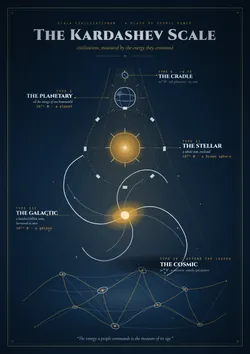
Between the first observations and the public excitement, Kardashev published the paper that introduced his scale. Type I used the energy of a planet, Type II the energy of a star, and Type III the energy of a galaxy. A tool for thinking about distant civilisations soon became a visual language for the future.
Why the ladder still works
The scale is not a census of alien societies. It is a way to imagine what their energy use might look like from a distance. Carl Sagan later made it continuous with decimal values, which made the comparison feel more precise than the evidence really was.
That tension is part of its appeal. The scale begins with a mistake, yet it gives science fiction a clear architecture. It turns a question about detection into a diagram about ambition, energy and the limits of observation.